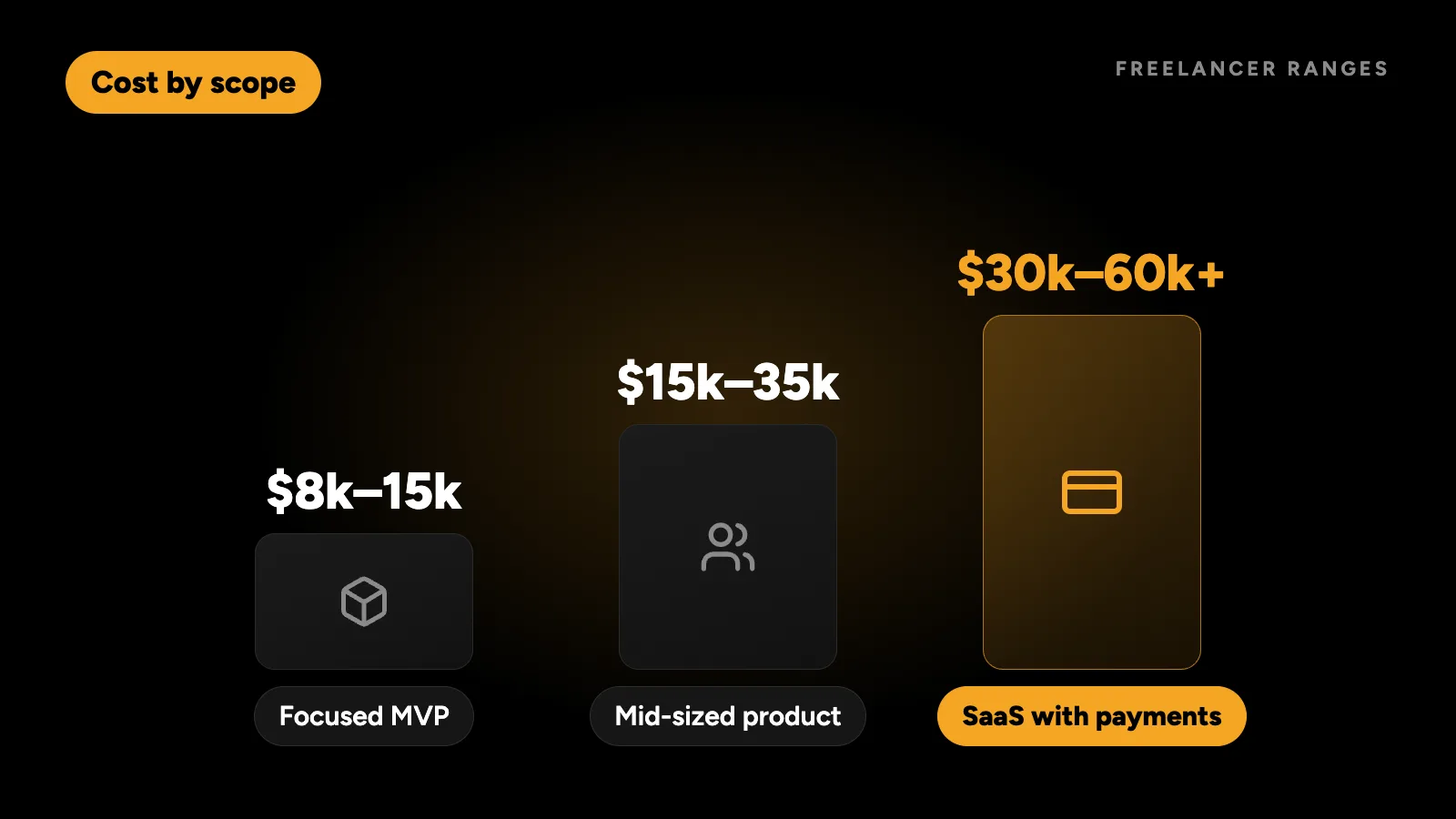
An MVP web app built with Node.js and a modern front end typically costs $8,000 to $15,000 for a focused first version from an experienced freelancer, $15,000 to $35,000 for a mid-sized product with several user roles and integrations, and $30,000 to $60,000 or more for a SaaS with subscriptions, an admin panel and reporting. Agencies in the US and UK usually charge two to three times those figures. The biggest lever on cost is scope: what you leave out of version one.
This guide gives realistic ranges, explains what moves the price and shows how to cut cost without cutting the parts that prove your idea.
What is an MVP, exactly?
A minimum viable product is the smallest version of your product that real users can sign up to, use and ideally pay for. It is not a clickable prototype and not a demo. It is a real product with a deliberately narrow scope, built to answer one question: do people want this enough to use it, or pay for it?
How much does an MVP cost by scope?
These are typical 2026 ranges in US dollars for a web app MVP on a Node.js backend with PostgreSQL and a Next.js or React front end.
| Scope | What it includes | Freelancer in India | Freelancer in US or UK | Agency (US, UK) |
|---|---|---|---|---|
| Focused MVP | Sign-up and login, one core workflow, simple admin, basic emails | $8,000–15,000 | $15,000–35,000 | $30,000–60,000 |
| Mid-sized product | Several user roles, dashboards, 2–4 integrations, file uploads, notifications | $15,000–35,000 | $35,000–80,000 | $60,000–150,000 |
| SaaS with payments | Subscriptions and trials, team accounts, admin and reporting, audit logs | $30,000–60,000+ | $60,000–120,000+ | $100,000–250,000+ |
Public budgets back this up. Across freelance and developer job posts, fixed budgets for MVP and SaaS builds have a median of around $11,000, with a long range from a few hundred dollars for “vibe-coded” prototypes to $50,000 for regulated products. Hourly rates for MVP work centre near $80 an hour for experienced developers in the US and Canada.
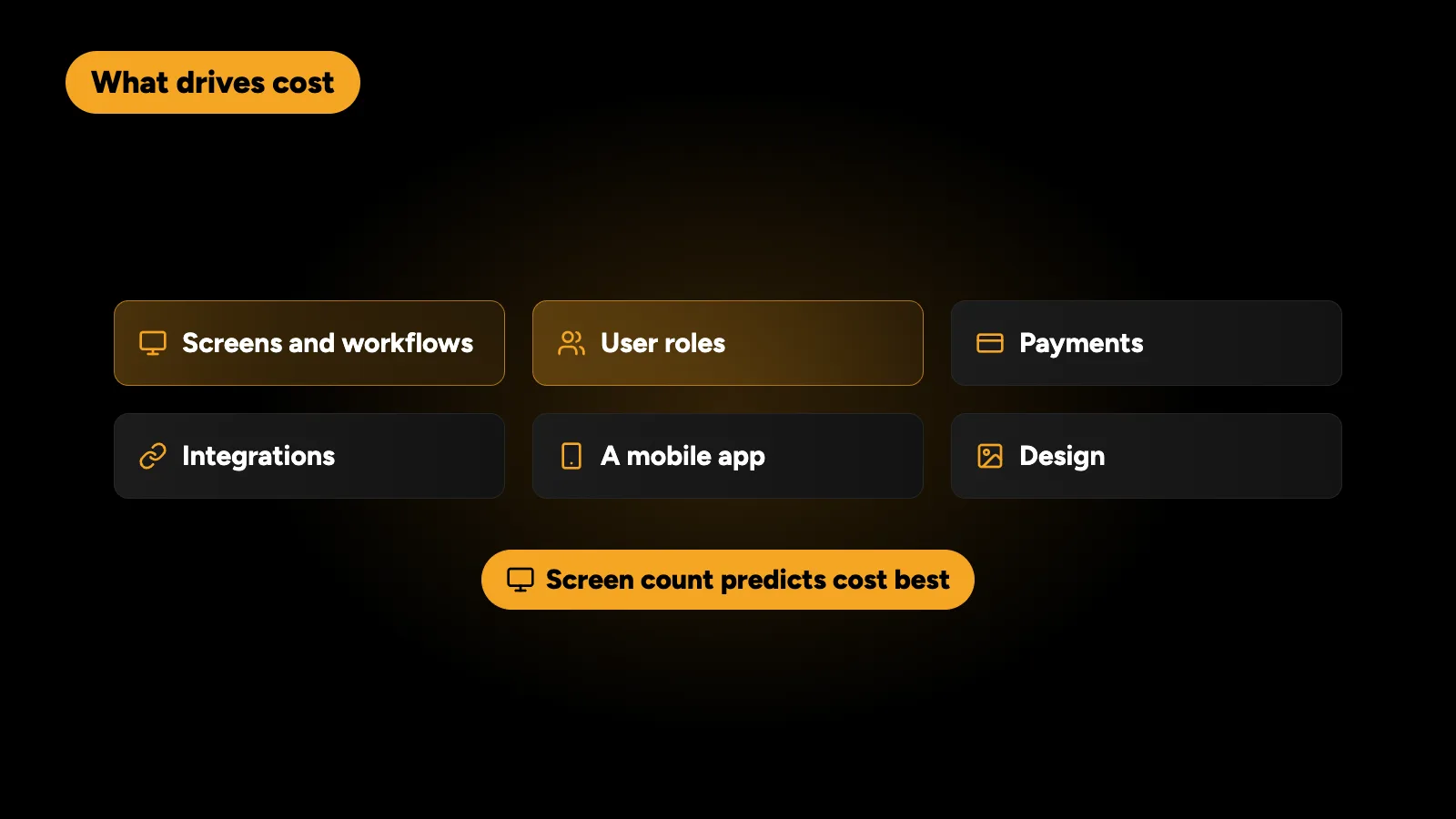
What drives the cost of an MVP?
Screens and workflows
Every screen has to be designed, built, connected to data and tested. Count the core screens a user needs to get value, then count the admin screens you need to run the product. That number is the best single predictor of cost.
User roles
A product with one type of user is simple. Add customers, staff, managers and admins, each seeing different data and actions, and the permission logic multiplies. Roles are one of the most underestimated cost drivers.
Payments
Taking payments means checkout, webhooks, receipts, failed-payment handling and refunds. Subscriptions add trials, upgrades, downgrades and cancellations. Payments are worth including in an MVP, because willingness to pay is the strongest signal you can get, but budget for them properly.
Integrations
Each external service, such as a CRM, maps, messaging, an AI API or an accounting tool, adds setup, error handling and testing. Some are an afternoon. Some are a week.
A mobile app
If your MVP needs an iOS and Android app as well as the web app, the cost rises substantially, though a shared backend keeps it below double. Usually a web app should come first; I explain when that changes in web app or mobile app. For mobile numbers, see how much a Flutter app costs.
Design
Using a solid component library with your brand colours is far cheaper than a fully custom design system. For an MVP, clean and consistent beats unique.
What are the ongoing costs after launch?
| Item | Typical monthly cost at MVP stage |
|---|---|
| Hosting for API, database and front end | $20–150 |
| Email sending, file storage, monitoring | $10–60 |
| Third-party APIs | Varies by usage |
| Domain | about $1–2 |
| Maintenance and small fixes | A few hours a month, or a retainer |
Payment processors take a percentage of each transaction rather than a monthly fee.
How do I reduce the cost of an MVP?
Cut features, not foundations.
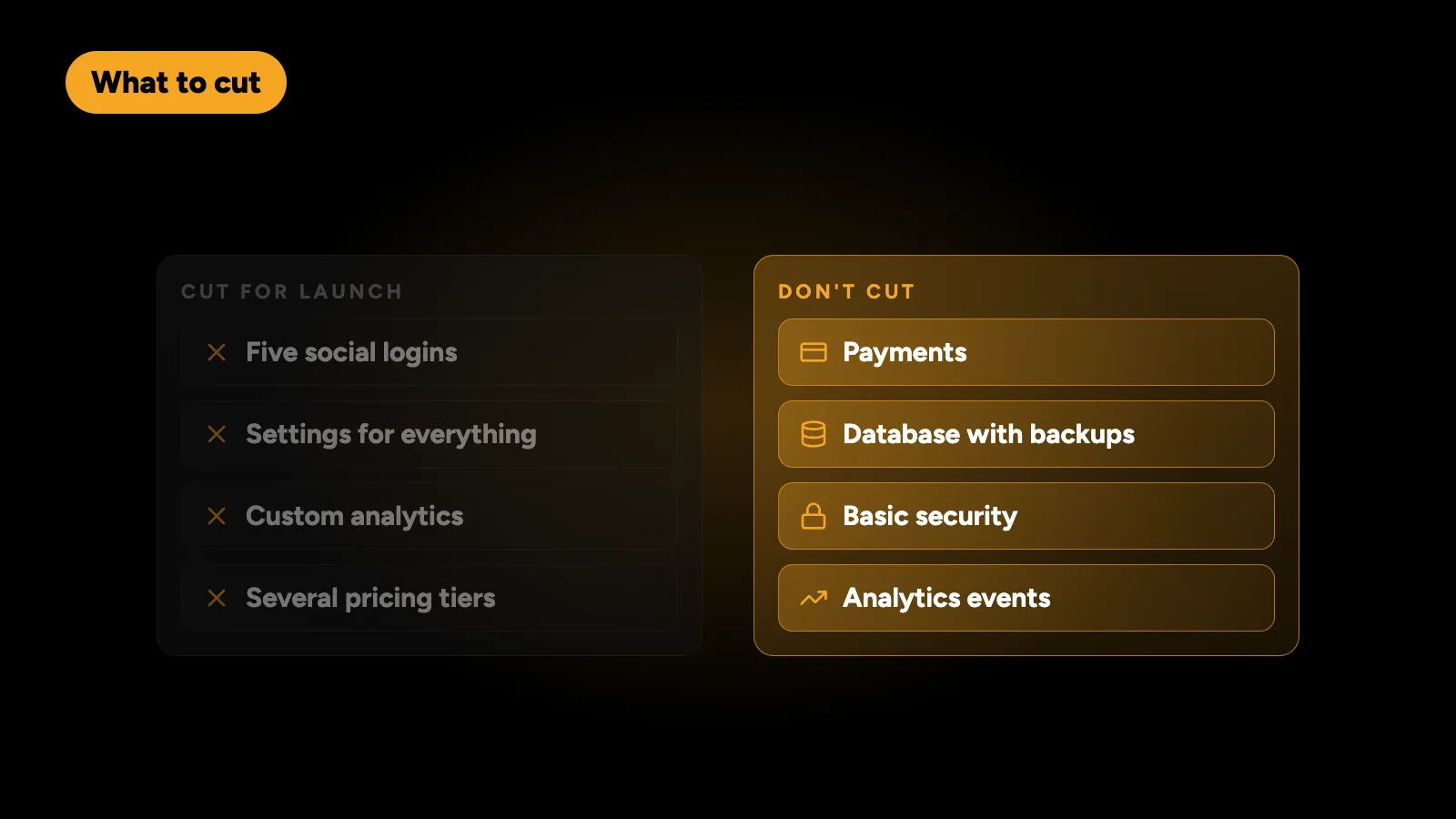
Cut for launch:
- Social login with five providers. Email plus one provider is enough.
- A settings page for everything. Choose sensible defaults.
- A custom analytics dashboard. Use a standard analytics tool.
- Admin tools for rare edge cases. Fix those by hand while users are few.
- Several pricing tiers. Start with one plan and a trial.
Don’t cut:
- Payments, if the business depends on people paying.
- A real database with backups.
- Basic security: hashed passwords, HTTPS, secret keys kept on the server, access rules checked on the server.
- Analytics events on sign-up, first use and payment.
Picking a sensible stack also saves money over time. My guide to choosing the right stack for a digital product covers that decision.
Is no-code or an AI builder cheaper?
Upfront, yes. Tools like Bubble, or AI app builders such as Lovable and Bolt, can produce a working prototype in days. They are excellent for testing an idea with a few users. The costs show up later: platform fees that grow with users, limits on what you can build, and code that may not be safe for real customer data or payments. If you already have an AI-built app, read is your vibe-coded app safe to launch? before inviting users.
How long does an MVP take?
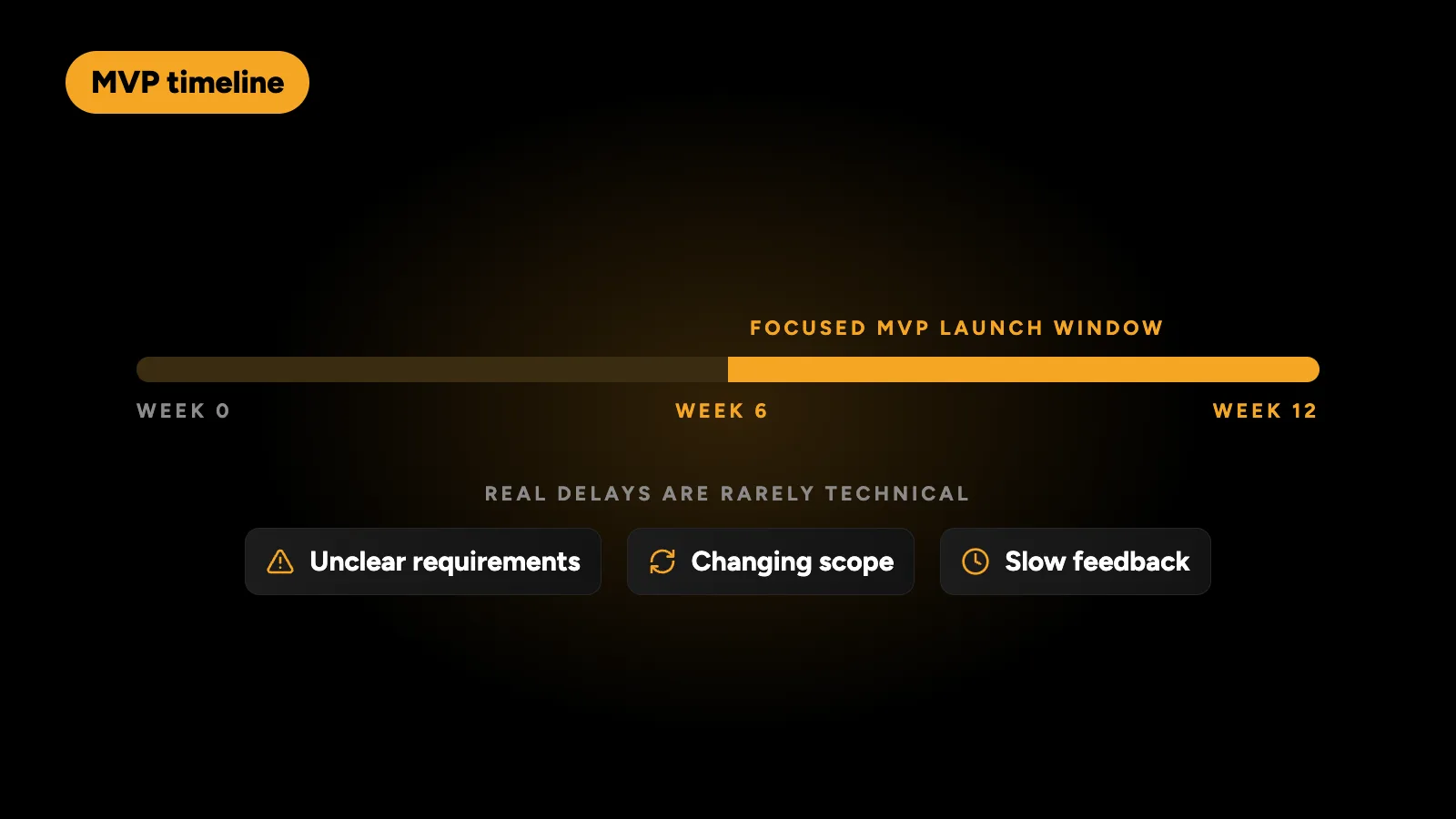
A focused web app MVP usually takes six to twelve weeks with an experienced developer, depending on scope and how quickly decisions are made. Mid-sized products take longer. The biggest delays are rarely technical: unclear requirements, changing scope and slow feedback cost more time than code.
What does a real MVP look like?
CRUD Review is a SaaS I architected from an empty repository and then led as a team of four to five people. It turns a short conversation at the counter into a detailed Google review. It has a Node.js, Express and PostgreSQL API, a Next.js web app and a Flutter app live on the App Store and Google Play, with subscriptions and a free trial through both stores’ billing. One backend serves every client, which is what kept the mobile app from doubling the cost.
How to get an accurate MVP quote
Write a one-page brief:
- The problem and who has it.
- The one journey that proves the idea.
- User roles.
- Payments: one-off, subscription or none yet.
- Integrations.
- Web, mobile or both.
- Your deadline and budget range.
I build MVPs for founders in the UAE, Australia, the US and the UK, from scope to launch, on a stack that grows into version two without a rebuild. Send the brief and get a fixed quote within 24 hours.